Gibreel Farishta’s suicide
The Satanic VersesGibreel Farishta’s suicide comes in the closing confrontation at Changez Chamchawala’s house, where an arrival by the police gives way to the discovery of a concealed revolver and then to Gibreel’s deliberate death. The scene makes a final contrast between the limitless possibilities of an old magical story and the brutally narrow choice offered by a weapon; in its aftermath, Saladin Chamcha turns from childhood enchantment toward an uncertain second chance.
Circumstances and the police arrival
Before the shooting, Saladin is thinking about a sequence of deaths and dangerous encounters. Sisodia, whose gift for chance meetings had brought him into contact with Gibreel in London traffic and with Saladin near an open aircraft door, has now met death by accidentally encountering Alleluia Cone in her hotel lobby. Saladin also thinks of Alleluia’s fatal descent, so different from the solitary Everest ascent she had longed to make, and of his own expected death for his verses. He cannot bring himself to call that sentence unjust. The juxtaposition places Gibreel’s impending act amid deaths that seem accidental, anticipated, or bound up with other people’s judgments, without making them equivalent to his choice.
A knock interrupts Saladin’s thoughts. From outside comes a request to open the door and the announcement that the police are there. Saladin realizes that Kasturba has called them after all. The arrival brings an immediate external threat into the room, but the scene does not proceed toward an arrest or rescue: Gibreel responds by reaching for an object that had appeared to be only a lamp.
The lamp and the concealed weapon
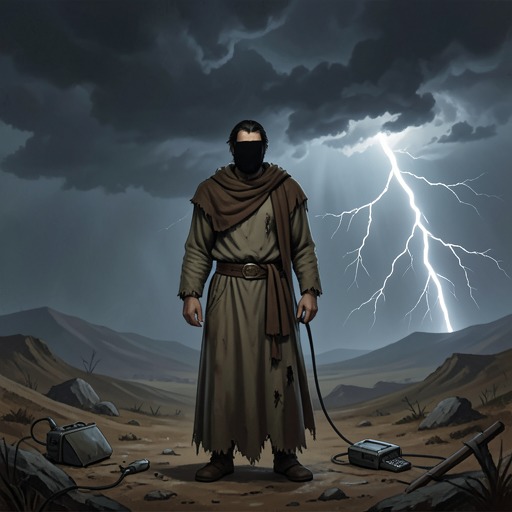
Gibreel removes the lid of Changez Chamchawala’s Wonderful Lamp and lets it clatter to the floor. Saladin recognizes the danger before the weapon is visible and shouts a warning that there is an armed man inside. The knocking stops. Gibreel rubs the side of the lamp three times; the revolver leaps into his other hand. The gestures recall the ritual of summoning a genie, but what emerges from the lamp is not a being able to make every wonder possible. It is a gun, and its power is devastatingly limited.
Saladin’s thoughts develop that contrast as the action unfolds. He remembers a fearsome genie offering to obey the holder of the lamp, then reflects that a weapon confines rather than enlarges the choices available. Now Gibreel is armed and Saladin is not; the universe seems to have shrunk to that stark difference. Against the genie of the old tale, with its gates to the Infinite and promise of unattainable wonders made attainable, the revolver is a degraded modern descendant: a forceful object with only a few possible outcomes. The magical object has not opened a world of possibility. It has concealed the means by which Gibreel will end his own life.
Gibreel’s decision
Gibreel speaks quietly to Saladin, recalling that he had long ago said he could not bear it if the sickness never left him, or if it returned again and again. The statement gives the shooting its immediate context: Gibreel understands the prospect of recurring illness as something he cannot endure. The scene does not specify a new episode at that moment; instead, his words connect this final decision to the sickness he had previously discussed with Saladin.
Before Saladin can move, Gibreel puts the barrel of the revolver into his mouth and pulls the trigger. The speed of the act leaves no time for Saladin to intervene. The narration ends the action with the words that Gibreel “was free.” That release is inseparable from the violence of the method: the story offers no rescue or reconciliation for Gibreel, only the finality of his choice. The concealed gun, first read as a threat to others, becomes the instrument of his suicide.
Saladin after the death
The narrative follows Saladin after the shot, shifting from the room and its weapon to the view from the window of his childhood. He looks toward the Arabian Sea, where moonlight stretching from the rocks of Scandal Point to the horizon creates the appearance of a silver road or a parting in the water. The image recalls a path to miraculous lands, but Saladin can no longer believe in fairytales. For him, childhood is over; the view has become a sentimental echo, and he accepts the coming of the bulldozers rather than insisting that the old remain.
Zeenat Vakil speaks beside him and offers to take him to her place. Saladin recognizes that, despite his wrongdoing, weakness, guilt, and humanity, another chance seems to be opening. Her offer does not undo Gibreel’s death or provide an accounting for it. Instead, it gives the closing movement a different outcome for Saladin: as one man dies because he cannot bear the return of suffering, the other is invited to leave the scene and continue living. The contrast gives the suicide its final significance without turning Gibreel’s death into a simple resolution for the survivor.